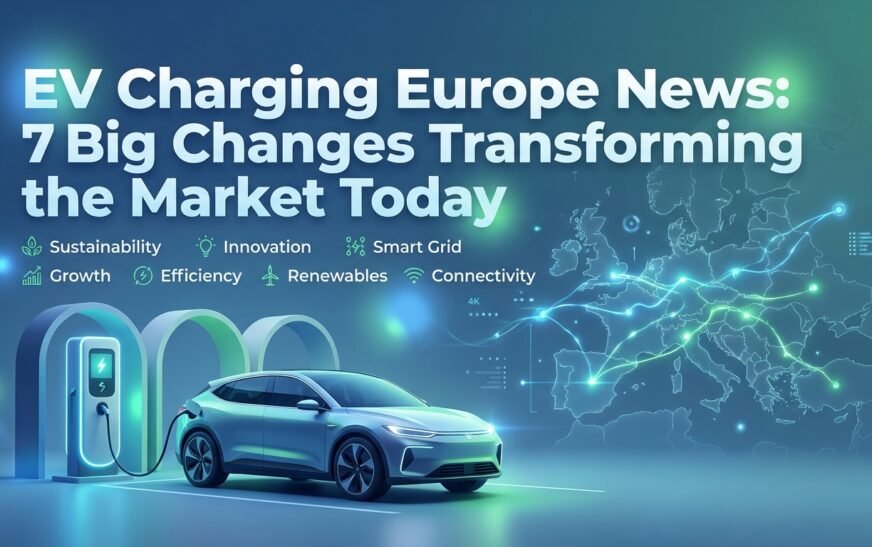
The electric vehicle (EV) revolution is moving faster than ever, and Europe is at the center of this transformation. If you’ve been following ev charging europe news, you already know that major shifts are happening—from infrastructure expansion to new regulations and cutting-edge technology.
In this article, we’ll break down the 7 biggest changes shaping the EV charging market in Europe today. Whether you’re a beginner, EV owner, investor, or just curious, this guide will help you understand what’s really going on—and what it means for the future.
Table of contents
- Why EV Charging Europe News Matters
- 1. Massive Expansion of Charging Infrastructure
- 2. Ultra-Fast Charging is Becoming the New Standard
- 3. Government Policies and Regulations Are Driving Growth
- 4. Rise of Smart Charging Solutions
- 5. Integration with Renewable Energy Sources
- 6. Increased Investment from Private Companies
- 7. Standardization and Interoperability Improvements
- Key Trends to Watch in EV Charging Europe News
- Challenges Still Facing the Market
- Future of EV Charging in Europe
- Frequently Asked Questions (FAQs)
- Conclusion
Why EV Charging Europe News Matters
Europe is leading the global transition toward clean transportation. Governments, automakers, and private companies are investing heavily in EV charging infrastructure.
Key reasons to follow EV charging trends:
- Rapid growth in EV adoption across Europe
- Strong government support and funding
- Increasing demand for fast and reliable charging
- Technological innovation in charging solutions
Staying updated with ev charging europe news helps you:
- Make smarter investment decisions
- Understand market trends
- Prepare for future mobility changes
1. Massive Expansion of Charging Infrastructure
One of the biggest updates in ev charging europe news is the rapid expansion of public charging stations.
What’s happening?
- Thousands of new charging points are being installed every month
- Highways, cities, and rural areas are getting better coverage
- Governments are setting strict targets for charger availability
Why it matters:
- Reduces range anxiety for EV drivers
- Encourages more people to switch to electric vehicles
- Supports long-distance EV travel
2. Ultra-Fast Charging is Becoming the New Standard
Charging technology is evolving quickly. Ultra-fast chargers are now a major focus across Europe.
Key developments:
- Chargers delivering 150kW to 350kW power
- EVs charging up to 80% in under 30 minutes
- Expansion of fast-charging networks along highways
Benefits:
- Saves time for drivers
- Makes EVs more practical for daily use
- Competes directly with traditional fuel refueling
3. Government Policies and Regulations Are Driving Growth
Government support is a major force behind EV adoption and infrastructure growth.
Important policy changes:
- Mandatory charging stations in new buildings
- Incentives for installing home chargers
- Funding programs for public infrastructure
Impact:
- Faster rollout of charging networks
- Lower costs for consumers
- Strong push toward sustainability goals
4. Rise of Smart Charging Solutions
Smart charging is transforming how electricity is used in EV charging.
What is smart charging?
It allows EVs to charge at optimal times using intelligent systems.
Key features:
- Load balancing to avoid grid overload
- Charging during off-peak hours
- Integration with renewable energy
Why it matters:
- Reduces electricity costs
- Improves grid stability
- Supports green energy usage
5. Integration with Renewable Energy Sources
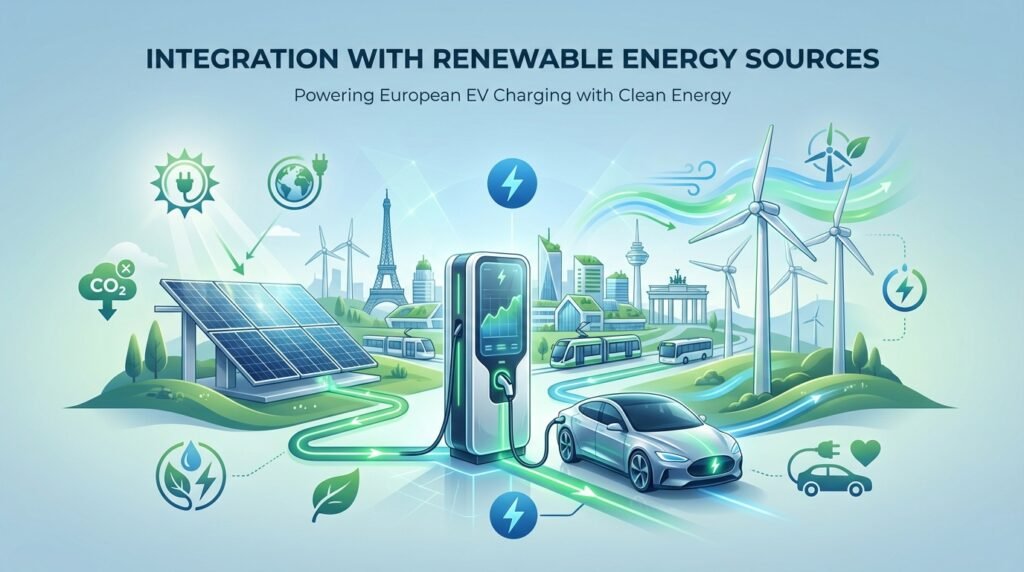
Another major highlight in ev charging europe news is the shift toward clean energy-powered charging.
What’s changing?
- Solar-powered charging stations
- Wind energy integration
- Green energy partnerships
Benefits:
- Reduces carbon emissions
- Supports Europe’s climate goals
- Makes EV charging truly sustainable
6. Increased Investment from Private Companies
Private sector investment is booming in the EV charging space.
Key trends:
- Energy companies entering the EV market
- Startups launching innovative charging solutions
- Partnerships between automakers and charging providers
What this means:
- Faster innovation
- Better user experience
- More competition leading to lower prices
7. Standardization and Interoperability Improvements
One of the biggest challenges in the past was compatibility between charging networks. That’s changing fast.
New improvements:
- Unified charging standards across Europe
- Roaming agreements between providers
- Single apps for multiple charging networks
Benefits:
- Easier access for EV users
- Seamless charging experience
- Less confusion for beginners
Key Trends to Watch in EV Charging Europe News
The EV charging landscape in Europe is evolving beyond just infrastructure growth. New technologies, smarter systems, and user-focused solutions are shaping the next phase of the industry.
Wireless Charging Innovation
Charging without cables is gaining attention as a future-ready solution. This technology allows vehicles to charge automatically when parked, improving convenience for everyday users.
Battery Swapping Solutions
Instead of waiting for a full charge, drivers can replace depleted batteries with fully charged ones. This approach is being tested in selected markets to reduce charging time significantly.
Vehicle-to-Grid (V2G) Technology
With V2G systems, electric vehicles can send electricity back to the grid. This helps balance energy demand and can even generate value for EV owners.
Smart Home Charging Growth
Home charging is becoming smarter and more efficient. Many systems now optimize charging during off-peak hours and integrate with solar energy systems.
Expansion of Residential & Street Charging
The focus is shifting from highways to neighborhoods. More on-street and residential chargers are being installed to support daily EV users.
Ultra-Fast & High-Power Charging
High-power charging (150kW–350kW and beyond) is becoming standard across Europe. New technologies like megawatt charging are also emerging for heavy vehicles.
Focus on Reliability & User Experience
Modern EV users expect charging to work like a basic utility. Reliability, uptime, and easy payment systems are becoming key priorities in the industry.
Challenges Still Facing the Market
Despite strong growth, the EV charging market in Europe still faces several critical challenges. These issues are slowing down large-scale adoption and affecting user experience.
⚠️ Uneven Infrastructure Distribution
Charging networks are expanding, but coverage is not equal across all regions. Some countries and cities have dense networks, while others still lack basic access.
⚠️ Grid Capacity Limitations
Electric grids are struggling to handle the growing demand for EV charging. In many cases, limited grid capacity delays new installations and increases deployment costs.
⚠️ High Costs for Operators and Users
Setting up and maintaining charging stations remains expensive. Rising energy and grid access costs are also pushing charging prices higher for consumers.
⚠️ Reliability and Maintenance Issues
Not all charging stations work as expected. Failed charging attempts, downtime, and maintenance delays continue to frustrate users.
⚠️ Slow and Complex Installation Process
Permits, regulations, and construction delays often slow down new charger deployment. As a result, infrastructure growth does not always match rising EV demand.
⚠️ Policy Uncertainty in Some Regions
Changing government policies can impact investment decisions. Inconsistent regulations may slow down infrastructure development and reduce investor confidence.
⚠️ User Experience and Payment Issues
Many users still face problems with apps, payment systems, and pricing transparency. A smooth and simple charging experience is still not guaranteed everywhere.
Future of EV Charging in Europe
The future looks extremely promising. Based on current ev charging europe news, we can expect:
- Millions of charging points by 2030
- Faster and more efficient charging technologies
- Full integration with smart cities
- 100% renewable-powered charging networks
Europe is clearly setting the global benchmark for EV infrastructure.
Frequently Asked Questions (FAQs)
It refers to the latest updates, trends, and developments in electric vehicle charging infrastructure across Europe.
Strong government policies, environmental goals, and increasing EV adoption are driving rapid growth.
Ultra-fast chargers can charge an EV up to 80% in around 20–30 minutes.
Coverage is improving quickly, but some rural areas still have limited access.
Smart charging optimizes when and how EVs charge to reduce costs and improve grid efficiency.
Yes, many stations are now using solar, wind, and other renewable energy sources.
The future includes faster charging, better infrastructure, and full integration with renewable energy and smart grids.
Conclusion
The latest ev charging europe news clearly shows that the market is evolving at an incredible pace. From ultra-fast chargers to smart energy integration, Europe is building a future-ready EV ecosystem.
Key Takeaways:
- Charging infrastructure is expanding rapidly
- Technology is making EV charging faster and smarter
- Governments and private companies are heavily investing
- Sustainability is at the core of all developments
For anyone interested in electric vehicles, keeping an eye on these changes is essential. The transition to a cleaner, electric future is not just coming—it’s already here.